Return of the Guack

If this evening feels a bit off—as if the air has to it a crisp quality not felt since the year 2007—it might have something to do with this being the third blog entry here within one month’s time. This may not be a feat to your average day-to-day blogger, but it smacks of something that, were it indeed “so yesterday,” Hilary Duff would correctly refer to as such.

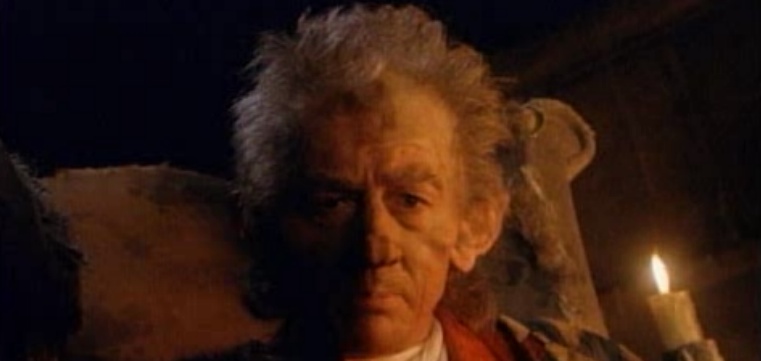
It’s actually much tougher to not maintain this site when my most recent entry contains John Hurt’s disapproving stare, a wisp-in-the-machine with shameful chains a-rattlin’.
On today’s episode I come tooting fanfare loud enough to shut that old grouch up for good. After bemoaning the digital loss of Gas Baby‘s hosting services, I was introduced to a new home for my comics. Now you can find it in its entirety (thus far!) here.
If you have never read it before I suggest you start at the beginning.

The Countdown List No One Asked For

I recently delved back into Jim Henson’s The Storyteller to address the timeless bone of contention that’s been beating under everyone’s floorboards for ages: What are the top 5 episodes? This is a loaded question, but I’m going to do my best to resolve the roaring debate at long last. Should I fail, I leave John Hurt to tell my story in astounding detail and with uncontested enthusiasm.

Being that there were only 13 episodes produced—and this includes the brief second series concerning Greek Myths—it’s not difficult to sit down and evaluate them yourself. They’re all on Netflix Instant Queue, so feel free to play along, agree or disagree.
First, a brief word on my criteria. Since this is a Jim Henson series, there’s a balance in the evaluation between story quality and puppet use, with the latter holding the power to truly tip the scales. Should two episodes be nose-and-nose in both categories, the draw comes down to how much the Storyteller’s Dog (voiced by Brian Henson) is featured.
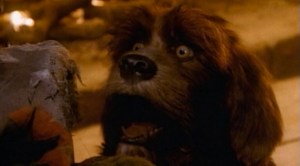
5. “A Story Short” Consider this The Storyteller’s “origin,” or at least something from his past that’s as close to one as is offered. Though many might long more for a tale of the dog’s background, “A Story Short” is a great little ditty on the nature of telling stories in general, in which our host recounts a time he was forced to tell a king a story a day. Should he fail, he’ll be boiled in the cook’s oil. Naturally, on the very last day of his service he runs out of ideas. That is, until something extraordinary (kind of a ye olde Inception) happens.
4. “Theseus and the Minotaur” While I enjoyed all four episodes of the Greek Myth series, this is probably the strongest. It doesn’t hurt that it also has the best monster, but overall it’s the most concisely told. Honestly, I could probably put all of Greek Myths in the fourth spot, because that series feels more like one anthology feature. Important note: no points were deducted for Michael Gambon replacing John Hurt as The Storyteller. Hurt is the man, but wouldn’t work in this context. Plus, the dog wanders the labyrinth with Gambon and constantly remarks on how “terrible” all the sad turns of the tragedies are.

3. “The Luck Child” A king attempts to kill a “luck child” that is prophesied to become king himself one day, discarding him into the ocean. Of course, with luck on his side the baby survives, and grows up just fine elsewhere. When the king runs into the child again 17 years down the line, he thinks of a new way to be rid of him. He’ll send him on the impossible quest of retrieving a golden feather from the murderous Griffin. The Griffin, pictured above, essentially has the face of one of Labyrinth‘s Fiery dudes. That and the old Ferryman pushed this episode ahead of contender “Fearnot.”
2. “The Heartless Giant” This little nugget came dangerously close to the top spot. It’s definitely the episode I remember most vividly from its original airing, and is the second directed by Jim Henson. Soon after a child frees a heartless giant imprisoned in his father’s kingdom, he discovers why he was put there in the first place. Setting out to right his wrong, he confronts the giant under the guise of servitude, helping tidy his enormous house while searching for the hiding spot of his heart. I really like giants.
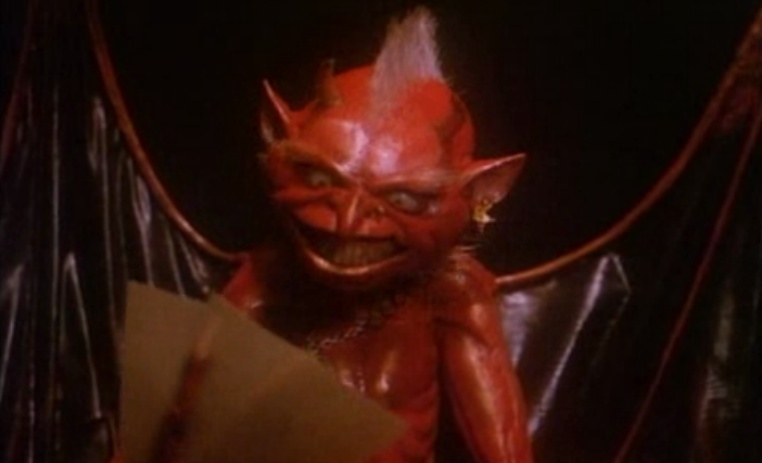
1. “The Soldier and Death” Since this is the very first episode of the series, they had to prove they were gonna go buckwild with the creature shop. Mission accomplished. The Devils are kind of like the goblins in Labyrinth; full of all kinds of, well, deviltry. Rather than explain the premise, I’ll just insist you watch the episode. If you don’t have Netflix, it’s all up on YouTube here. If you’re too lazy to do that right now, just watch The Devils in action. Is it mere coincidence the #1 pick is home to the only other episode directed by Henson? Probably not.
So there you have it. Now all your deepest curiosities may lay to rest at last. Go and tell the world how momentarily satisfied you are, and enjoy your peaceful respite.


Yo, Luster, Where You At!?

I’m right here, hopping on my blog to update about something not related to Castlevania! It totally sucks to be my blog in 2010, doesn’t it? I feel kind of bad for the fella, but I think it’s full of so many kick-ass blog entries that I’m almost intimidated to touch it at times. It’s like I crafted a real babe of a blog and now it’s just shakin’ its hooters in my face and I’m all lowering my shades as if to say “tadow!”

Or it’s like my blog has become cool dog and I just expect it to act cool on its own.

Anyway, it’s really tempting just to jump to the end of those Castlevania stories and move on, but I like to finish things I started properly (which is why I’ll still be drawing Gas Baby when I’m 60 [by the way, let me sub-parenthetically pick a bone real quick. The place I normally host Gas Baby was ComicSpace, but they, uh, I don’t even know. It’s not there anymore, though. I guess that means it’s time to start a proper GB site or something]).
Speaking of proper sites (whoa, I just continued from a parenthetical statement, is that allowed?), I renewed josephluster.com for another two years. Now you vultures can just scram, because it’s mine.
The whole reason I came here to post is because the latest issue of Otaku USA is out. This is the cover.

I’d say I “literally know nothing” about Hetalia, the cover story, but that’s not true. I do, however, literally know next to nothing about it and would like to keep it that way. I hear it’s quite popular with the kiddies, though.
I wrote about the following: TV Games, Dragon Ball Z Kai, and the live-action adaptations of 20th Century Boys. Don’t believe me? Peep the TOC. Also peep the site in general, it’s my freakin’ day job.

Luster’s Quest: The Castlevania Adventure pt. III

Lots of stuff going on; I almost forgot about this!

I want to kick this entry off with a YouTube video that serves two purposes. One, it showcases the powerful effect of Holy Water in Castlevania; this video quite literally overhauled the way I look at the game. Two, it features one of my favorite songs by one of my favorite chiptune artists, Cheap Dinosaurs.

Now that you’ve chewed on that, you can see how handy this item is. Even if you were already well aware, I most certainly was not. In fact, my history with the series had my friends and I avoiding Holy Water by any means necessary, as if its essence would spill out into Belmont’s grip and burn him like the sinner he surely is.


So yes, it was Holy Water that got me over that ages-old obstacle of Death. Though my victory over every man’s inevitable defeat remains a programmed illusion, I found solace in the concept of besting the Reaper, even in this virtual world.

Death remains just that, though: an obstacle. The real Summit of Man’s Might rests atop Dracula’s castle, and the battle to get there offers up some of Castlevania‘s fiercest challenges yet. Against the odds, my accomplishment awoke in me a primal drive to finally see this game to its end, and see it I did.

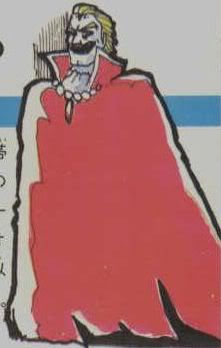
Let’s talk about Dracula for a second. Though we won’t get to speak of the ULTIMATE Drac fight for a few more entries, the battle that goes down in Castlevania is pretty worthy of a final boss. Just look at that smug bastard!

But it’s not until you whip his freakin’ head off that he reveals his true form. As cartoons, comics and games have taught us, the Japanese have an interesting concept of Count Dracula. He is somewhat of a snaggletooth’d gremlin-devil here, and he’ll wallop ya! There’s nothing more crushing than facing defeat near the end of a boss’s second form, but it makes the win that much sweeter, and it’s one of many reasons I couldn’t stop talking about finally beating Castlevania after so many years.

For those wondering, I did indeed involuntarily pump my fist and exclaim “Yes!” like a sugar-struck child of roughly 11.

Most importantly, I feel like I can fully appreciate the game now. I’ve called it cheap many times in my life, but it’s really not. Like many NES games, it has its fair share of “issues,” but it’s pretty well designed and it holds up to repeat play. Best of all is the fact that you can start right at level one after the credits roll, kicking off a much more difficult version of the game.

While you bask in my personal glory, I leave you with another song:

Listen: Wicked Child

Coming up next: Simon’s Quest!

Luster’s Quest: The Castlevania Adventure pt. II

I thought long and hard about this, because as a freelance writer, that’s what I get paid to do. What good would I be if I couldn’t scoot my chair over to a window overlooking the marvelous vista of Hoboken and ponder important matters like “I wonder how I should go about blogging my Castlevania experience?”

Let’s get an executive order out of the way first. This shit’s going down in roman numerals. That’s the first thing I’m changing right off the “bat” (get it?). If you can’t read ’em, this is part 2. I’m also going long with this, because I don’t have anything else to write about on the JLR at the moment, so bear with me.


The original Castlevania has been a TV game thorn in my side since my youth. It became one of many classics that I wrote off as something I would just never finish. It wasn’t meant for me to complete; it was crafted for greater savages. The issue I always held with this, however, is that I love the series. Even in the face of great difficulty, it’s like something that was created specifically for my tastes. Dracula! Mummies! A freakin’ Frankenstein (or “The Monster” for you purist nerds)! Fleamen!


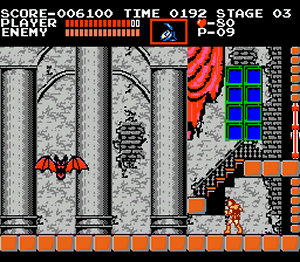
But no matter how hard I went at it, there was always a little roadblock by the name of Death. As in all ‘Vanias, he awaits the player in his chamber, where he proceeds to rain the terror of a dozen flying scythes upon their heroic person. By the time you get to him in stage 5, a mere four or so hits spells death for Simon Belmont (or Belmondo, if you like). This is maddening, and usually results in Simon bouncing around the room like a rag doll before collapsing in a pile of shame and embarrassment.


Previous attempts over the years had me doing just that, if I even made it there at all. However, somehow I had never been privy to knowledge of the “Holy Water trick.” Once I saw the above .gif, I knew I might actually have a chance of making it past Death, if not Dracula himself.

The next entry in this voluminous yarn will explore just how this opened the gates for conquering Dracula’s gnarly castle. For now, I leave you with a track from the game, something I’ll be doing with each post from here on out. This is probably my favorite song from Castlevania, and I think it took that title because I had to play stage 5 so many times that it burned itself into my mind like a searing brand against a horse’s ass.

Listen: Heart of Fire